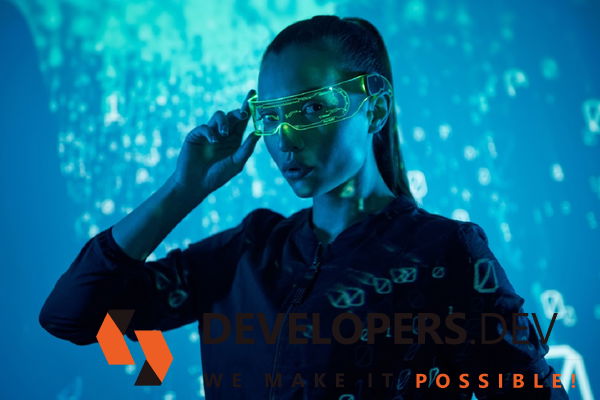
The potential of Augmented Reality (AR) and Virtual Reality (VR) to redefine enterprise operations, from remote maintenance to immersive training, is undeniable.
Yet, the journey from a brilliant, raw concept-a 'napkin sketch' idea-to a secure, scalable, and functional enterprise application is fraught with technical complexity, budget risks, and talent scarcity. This is where most ambitious projects stall.
As a global tech staffing strategist, we understand that for a CTO or VP of Innovation, the challenge isn't the idea itself, but the execution.
You need a predictable, high-quality process that mitigates risk and ensures your investment delivers measurable ROI. This blueprint provides the strategic, phased approach-backed by CMMI Level 5 process maturity-to convert your raw ideas into functional AR VR apps that drive real business value.
Key Takeaways for Executive Decision-Makers
- 💡 Structured Validation is Non-Negotiable: Before writing a single line of code, rigorously validate the AR/VR idea's core value proposition (CVP) and technical feasibility to avoid costly pivots later.
- 🛠️ Talent Model Dictates Success: Relying on fragmented freelance talent introduces risk. A dedicated, in-house Augmented-Reality / Virtual-Reality Experience Pod ensures continuity, security, and CMMI Level 5 quality.
- 💰 Prioritize the MVP: Focus on a Minimum Viable Product (MVP) with core features to achieve a faster time-to-market. According to Developers.dev research, enterprises that utilize a dedicated, in-house AR/VR POD achieve a 30% faster time-to-market compared to those relying on fragmented freelance teams.
- 🔒 Security and Integration First: Enterprise AR/VR apps must be secure (SOC 2, ISO 27001) and seamlessly integrate with existing systems (SAP, CRM) for true scalability.
Phase 1: Idea Validation and Blueprinting (The Strategic Foundation) 🗺️
Key Takeaway: The first phase is a strategic audit, not a coding exercise. Define the core business problem and validate technical feasibility to create a solid AR VR app development blueprint that prevents scope creep and budget overruns.
A raw idea is a vision; a blueprint is a plan. For enterprise-grade AR/VR, this phase is critical for de-risking the entire project.
It's about answering the skeptical CFO's question: 'What is the measurable return on this investment?'
Defining the Core Value Proposition (CVP) and Use Case
Your AR/VR application must solve a high-value problem. Is it reducing training time by 40% (VR training), or improving first-time fix rates by 15% (AR remote assistance)? We help you distill the idea into a clear CVP, focusing on the specific user interaction and the business metric it will impact.
Technical Feasibility and Platform Selection
The choice of technology stack-Unity, Unreal Engine, WebXR, or native SDKs (ARKit, ARCore)-is a long-term decision.
It impacts performance, device compatibility, and future maintenance costs. Our experts conduct a thorough analysis, considering factors like required graphical fidelity, device ecosystem (HoloLens, Meta Quest, mobile), and integration points with your existing enterprise architecture.
AR/VR Idea Validation Checklist for Executives
| Criterion | Question | Go/No-Go Metric |
|---|---|---|
| Business Value | Does this solve a problem worth >$X in savings or revenue? | Must impact a core business KPI by >10%. |
| Technical Feasibility | Can the required spatial tracking, rendering, and processing be achieved on target devices? | Proof-of-Concept (PoC) must show <50ms latency. |
| User Adoption | Is the target user group willing and able to use this technology? | User survey must show >75% willingness to adopt. |
| Integration | Can it securely connect to our existing ERP, CRM, or data systems? | Clear API/middleware strategy defined. |
| Scalability | Can the application support 1,000+ users globally without performance degradation? | Cloud architecture (AWS/Azure) must be defined for global scale. |
Is your AR/VR idea technically sound and financially viable?
Don't let a great concept fail due to flawed execution. Our Enterprise Architects provide a rigorous feasibility assessment.
Start your AR/VR project with a CMMI Level 5-certified blueprint.
Request a Free QuotePhase 2: Prototyping and UX/UI Design (The Human-Centric Experience) 🎨
Key Takeaway: AR/VR is a spatial medium, not a flat screen. Success hinges on a user experience (UX) that is intuitive, comfortable, and truly immersive.
This requires specialized design expertise.
In AR/VR, a poor user interface (UI) can literally make your user sick (VR sickness). This phase is where the abstract idea takes its first tangible form, focusing entirely on the user journey and interaction design.
Wireframing and Storyboarding for Spatial Computing
Traditional wireframing is insufficient. We use spatial storyboarding and low-fidelity prototypes to map out user movement, gaze interaction, and object manipulation within the 3D environment.
This is the equivalent of using tools like Balsamiq For Web Designers Turning Ideas Into Layouts, but adapted for a three-dimensional space. This early visualization saves hundreds of development hours by catching fundamental design flaws.
The Critical Role of UX/UI in AR/VR
Our dedicated User-Interface / User-Experience Design Studio Pod specializes in spatial computing design principles.
This includes optimizing field-of-view, minimizing cognitive load, and ensuring accessibility compliance. For example, in a VR training module, the placement of menus and interaction cues must feel natural to prevent disorientation.
Phase 3: Minimum Viable Product (MVP) Development (The First Functional App) 🚀
Key Takeaway: The MVP is the fastest path to market validation. It must be functional, secure, and built on a scalable architecture, not a throwaway prototype.
This is where the prototyping AR VR ideas phase transitions to a production-ready build.
The goal of the MVP is to prove the CVP with the minimum set of features required to delight early adopters and secure further investment.
This requires surgical precision in feature prioritization.
Core Feature Prioritization and Agile Sprints
We leverage our Augmented-Reality / Virtual-Reality Experience Pod to execute development using an Agile methodology.
This ensures rapid iteration and continuous feedback. The focus is on the core, non-negotiable features that deliver the primary business value. Everything else is deferred to Phase 4.
AR/VR MVP Feature Prioritization Matrix
| Feature Category | Example (VR Training) | Priority (Must-Have/Should-Have/Nice-to-Have) |
|---|---|---|
| Core Functionality | Accurate 3D object interaction and physics simulation. | Must-Have |
| User Management | Secure login and basic user profile. | Must-Have |
| Data Capture | Tracking of user performance metrics (e.g., time to complete task). | Must-Have |
| Multiplayer/Collaboration | Real-time interaction with one other user. | Should-Have |
| Advanced Analytics | Deep-dive performance dashboards. | Nice-to-Have |
Understanding feature prioritization is key, whether you are building a complex enterprise app or a simpler platform.
For a broader view on feature sets, consider the functional capabilities discussed in Types Of Social Media Apps And Their Functional Capabilities.
Choosing the Right Development Model
For a high-stakes AR/VR MVP, the talent model is paramount. Our model of 100% in-house, on-roll employees-not contractors-ensures full commitment and IP security.
You can choose a Fix fees-Project basis for a defined MVP scope or a POD (Cross functional teams) basis for maximum flexibility and dedicated expertise.
Phase 4: Scaling, Security, and Enterprise Integration (The Future-Proofing) 🌐
Key Takeaway: A successful MVP is just the start. Enterprise-grade AR/VR requires robust security, seamless integration with existing systems, and a clear path for continuous improvement and global deployment.
Once the MVP is validated, the focus shifts to industrializing the application. This is where the complexity of enterprise IT meets the cutting edge of spatial computing.
Integrating AR/VR with Existing Enterprise Systems
Your AR/VR app is useless if it exists in a silo. It must securely communicate with your core systems. For example, an AR maintenance app needs to pull real-time work order data from SAP or a custom ERP.
Our expertise in system integration ensures a smooth, secure data flow, which is crucial for a global operation across the USA, EU, and Australia.
Ensuring Security and Compliance
Data privacy and security are non-negotiable. Our CMMI Level 5, SOC 2, and ISO 27001 accreditations provide the peace of mind that your sensitive data and intellectual property are protected.
We offer White Label services with Full IP Transfer post-payment, a critical assurance for enterprise clients.
The Role of MLOps in AR/VR Scaling
Many AR/VR applications rely on Machine Learning (ML) for object recognition, spatial mapping, or personalized experiences.
Scaling these models requires a robust MLOps strategy. Our Production Machine-Learning-Operations Pod ensures that your ML models are continuously monitored, updated, and deployed reliably across all devices, a concept we detail further in Building Smarter AI Integrating Mlops Into Your Devops Workflow.
2025 Update: The AI-Augmented AR/VR Development Edge 🤖
Key Takeaway: Generative AI is rapidly transforming the AR/VR asset pipeline, promising to reduce content creation costs by up to 50%.
Future-winning solutions must leverage this.
The landscape of enterprise AR VR development process is being fundamentally reshaped by AI.
In 2025 and beyond, the competitive advantage lies in integrating AI not just into the application's features, but into the development process itself.
- ✨ Generative AI for Asset Creation: Tools are now capable of generating high-fidelity 3D models, textures, and environments from simple text prompts, drastically accelerating the content pipeline.
- 🧠 Edge AI for Performance: Deploying smaller, optimized ML models directly on the AR/VR device (Edge AI) for real-time object recognition and spatial understanding, reducing reliance on cloud latency.
- 📈 AI-Enabled Quality Assurance: Using AI to automate the testing of complex spatial interactions and performance under various network conditions, ensuring a flawless user experience.
Developers.dev is at the forefront, utilizing our AI enabled services and AI / ML Rapid-Prototype Pod to deliver this next generation of spatial computing applications.
Your AR/VR Vision, Engineered for Enterprise Success
The leap from a raw idea to a functional, revenue-generating AR/VR application is a complex, multi-phased engineering challenge.
It requires more than just coding; it demands strategic planning, specialized UX/UI expertise, CMMI Level 5 process maturity, and a globally aware, secure delivery model.
By following this enterprise blueprint, you can confidently convert your raw ideas into functional AR VR apps that are not only innovative but also scalable, secure, and integrated into your core business.
Don't settle for a body shop; partner with an ecosystem of experts.
Reviewed by Developers.dev Expert Team
This article reflects the combined expertise of the Developers.dev leadership and technical teams, including insights from our Certified Cloud Solutions Experts (Akeel Q., Arun S.), Microsoft Certified Solutions Experts (Atul K., Nagesh N., Yogesh R.), and our UI, UI, CX Experts (Pooja J., Sachin S.).
Our commitment to CMMI Level 5, SOC 2, and ISO 27001 standards ensures that the strategic guidance provided is grounded in verifiable process maturity and global best practices.
Frequently Asked Questions
What is the typical timeline for developing an enterprise AR/VR MVP?
The timeline can vary based on complexity, but a well-defined AR/VR MVP, following a rigorous blueprinting phase, typically takes 3 to 6 months.
This is achievable by leveraging a dedicated, cross-functional team like our Augmented-Reality / Virtual-Reality Experience Pod and focusing only on the core, non-negotiable features. Our process is designed for rapid iteration, ensuring a 30% faster time-to-market compared to fragmented teams.
How does Developers.dev ensure the security and IP of my AR/VR application?
Security and IP protection are paramount. We are CMMI Level 5, SOC 2, and ISO 27001 certified, demonstrating verifiable process maturity.
All development is conducted by 100% in-house, on-roll employees, not contractors. Furthermore, we offer a White Label service with Full IP Transfer post-payment, providing maximum legal and operational security for our majority USA, EU, and Australia-based clients.
What is the cost model for AR/VR development with Developers.dev?
We offer flexible billing models to suit your project stage and budget:
- Fix fees-Project Basis: Ideal for a clearly defined MVP or a fixed-scope project.
- T&M (Time & Material): Best for projects with evolving requirements or R&D phases.
- POD (Cross functional teams) Basis: Our most popular model, providing a dedicated, scalable team of experts (developers, designers, QA) for long-term, strategic development. This model offers the best balance of cost-effectiveness and quality.
Ready to move beyond the 'napkin sketch' and build a functional AR/VR enterprise app?
Your raw idea has immense potential. Don't let it be compromised by talent gaps, security risks, or unpredictable costs.
Our CMMI Level 5-certified, in-house experts are ready to execute your vision.